
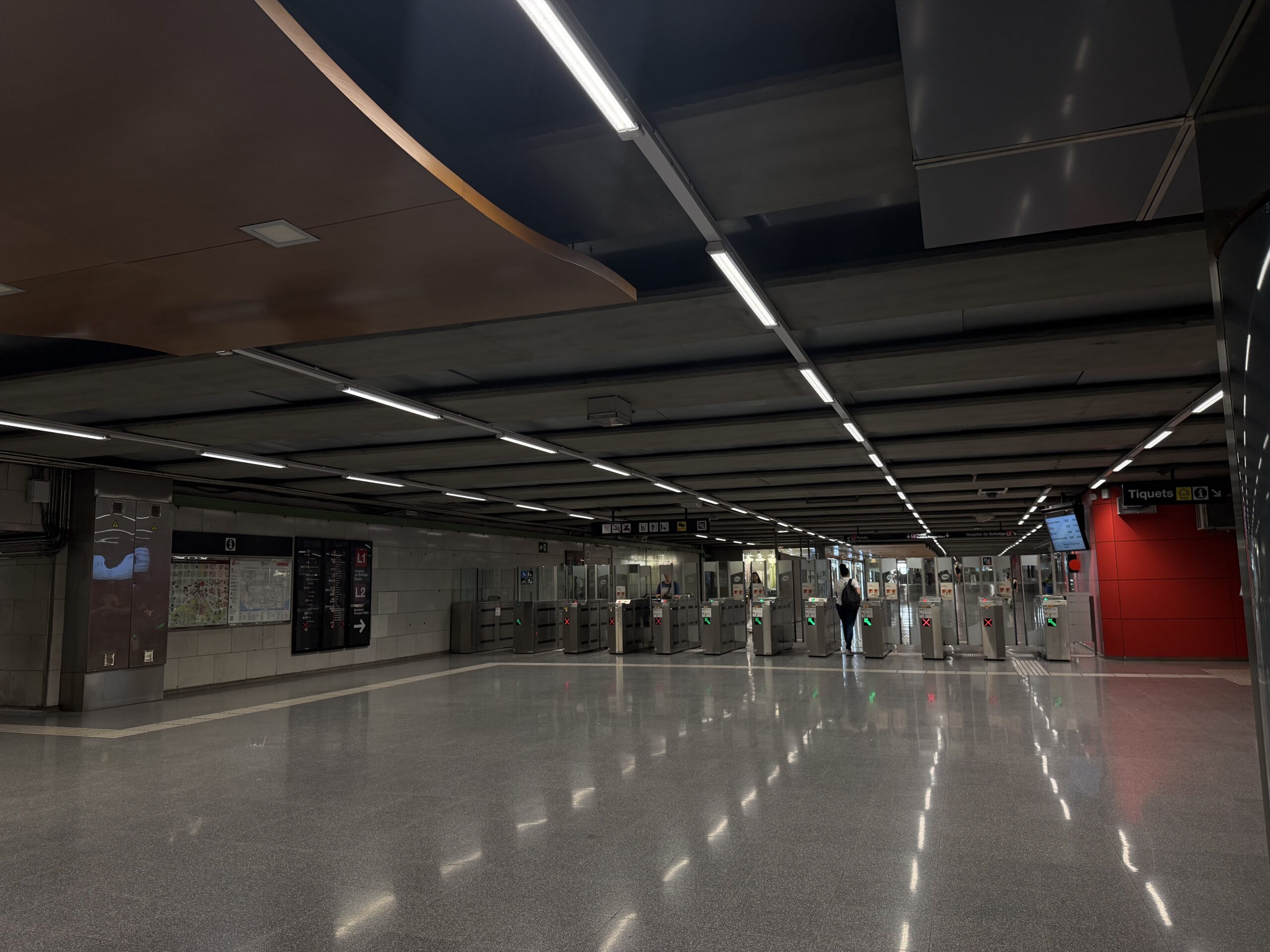

The Barcelona metro is the fastest way to move around the city and easy to use once you understand where it goes and how the tickets work. This covers how to use it, what to buy as a resident versus what’s built for tourists, the zone system, the discounts most people never hear about, the rules for traveling with a dog, and the stops worth knowing by name.
How the Barcelona Metro Works

The Barcelona metro has 12 lines and more than 150 stations, and every line, transfer, and stop is laid out on TMB’s official Barcelona metro map. Download the official TMB app for quick access to maps, real-time updates, and news about service interruptions.
Using it is straightforward: tap your ticket, card, or mobile phone (through the TMB app) at the turnstile to enter, and tap again at any transfer within the system if you’re switching between metro, bus, tram, or train under the same journey. You don’t need to tap again to exit the metro itself (unless you transfer to Rodalies trains, which sometimes requires a tap to exit) but you do need to tap at every new boarding — for example, when transferring to a bus — because skipping it risks a fine even if you technically hold a valid pass. Metro officials occasionally check validated cards at the exits, particularly during rush hour.
Penya Tip: You can get your T-mobilitat card mailed to you for free (within Spain) by requesting it through the TMB website or app, which skips the station machine queue entirely. A digital version is also available for your phone through the TMB app. One heads-up for non-Spanish accounts: the mobile card works with Spanish mobile wallets but can run into compatibility issues with American Apple or Google accounts. The workaround is to temporarily switch your App Store or Google Play region to Spain to download the card, then switch back if you need to.
Barcelona Metro Zones, Explained
Barcelona’s public transport runs on seven concentric fare zones radiating out from the city center, and almost everything you’ll do day to day falls inside Zone 1.
Zone 1 covers Barcelona itself along with the closest municipalities in the metropolitan area (under “the metropolitan fare”), so if you’re asking whether a specific attraction is in Barcelona Zone 1, the honest answer for nearly anything inside the city limits is yes. Park Güell, for example, is entirely within Zone 1, despite sitting up in the Gràcia/Carmel hills, so you don’t need a multi-zone ticket to reach it.
You only need to think about zones when you’re heading further out to towns like Sitges or deeper into Catalonia, where your ticket needs to cover as many zones as you actually cross. TMB publishes an official Barcelona zone 1 map alongside the full zone chart, worth checking before you buy if your trip leaves the city.
Barcelona Metro Tickets: What Residents Should Actually Buy

The T-Casual and T-usual are the two standard ticket options for residents. Buy the T-Casual if you ride occasionally or the T-usual if you commute daily.
- T-Casual: 10 journeys on a personal card, priced from around €13 (fares are subject to change and are occasionally discounted)
- T-usual: unlimited journeys for 30 consecutive days, from around €22.80, and unlike the T-Casual, it covers the airport metro line
- Single ticket: one journey, around €2.90, valid on metro, bus, and the Montjuïc funicular. Fine for a single trip but a poor deal if you travel more frequently
- T-jove: unlimited travel across all zones for 90 days for residents under 30, from around €45.50
- T-16: completely free for children and young people aged 4 to 16, unlimited journeys within the valid zone. If you’re moving here with kids, this is worth registering as soon as they’re eligible
Multi-Person and Family Passes
If you’re traveling as a household rather than solo, two passes are built specifically for that:
- T-familiar: 8 journeys shared across multiple people within 30 days, from around €11.50. Sized for a family that rides together occasionally, not daily.
- T-grup: 70 journeys shared across multiple people within 30 days, from around €91. Better for a household or small group that rides frequently.
If anyone in your household qualifies as a single-parent family (família monoparental) or large family (família nombrosa — general or special category), TMB offers meaningfully discounted versions of the T-usual, the 70-journey multi-person pass, and the T-jove specifically for that status, cutting the standard price by roughly a third to half depending on category. TMB recognizes two tiers: general (three or four children, or two if one child has a disability) and special (five or more children), with deeper discounts at the special tier. It’s easy to miss because it isn’t discussed as frequently as the standard tickets, so it’s worth checking if your household might qualify.
What Happened to the T10 and T-Mes?
If you’re seeing older guides reference a “T10” or “T-Mes,” they’re describing tickets that no longer exist under those names. TMB moved its ticketing onto the T-mobilitat digital system, and in the process renamed its core products: the old T-Mes (a monthly pass) became the T-usual, and the classic T10 (a 10-journey card) became the T-Casual. If you’re also seeing “T-50/30” mentioned somewhere, that was an older 50-journey, 30-day multi-trip card that doesn’t have a direct 1:1 replacement today. Depending on how much you actually ride, the closest current equivalents are the T-Casual for occasional use or the T-usual for more frequent travel.
Buying Tickets Online
You can buy every ticket listed here directly through TMB’s website or the TMB App, without a station visit. Fill in the form, pay, and the ticket loads onto your T-mobilitat card or phone, ready to validate at your first tap.
Where else does your ticket work? Barcelona’s transport runs on one integrated fare system, which means your T-Casual, T-usual, or single ticket isn’t limited to the metro. The same validation covers TMB buses, the Trambaix and Trambesòs trams, FGC trains, and Rodalies regional trains, and you can make up to three transfers between them within your ticket’s time and zone limits without it costing you an extra journey. The Montjuïc funicular is also included on the single ticket specifically. Check the fine print on tourist passes like the Hola Barcelona Travel Card separately, since coverage details can differ slightly from the standard resident tickets.
What Tickets Are Actually Built for Tourists
The Hola Barcelona Travel Card is the one built for short stays: unlimited travel for a set number of consecutive days (1 to 5), priced from around €12.50, with return airport metro trips included. It’s a reasonable option for a visiting friend or family member, but a poor deal for a resident, since a T-Casual or T-usual works out cheaper the moment you’re riding regularly rather than for a handful of days.
The Best App for the Barcelona Metro
The TMB App is the one to install first; it covers real-time arrivals, route planning across every mode in the integrated system, and buying or storing your tickets digitally, so you’re not relying on station machines every time. Google Maps is a solid backup, especially for routes that mix walking with transit.
Barcelona Metro Hours and Timetable
The metro generally runs from around 5 AM to midnight on regular weeknights, extending to 24 hours on Friday and Saturday nights and the night before public holidays.
On the nights it isn’t running 24 hours, the Nitbus night bus network covers the gap after the metro closes, though it’s slower than the metro itself. If you’re planning a night out, check the specific timetable for your line before you go because individual lines can have slightly different closing times and the TMB App shows this in real time rather than relying on a general rule of thumb.
Metro Rules for Dogs and Other Pets
Dogs are allowed on the Barcelona metro, but only within specific hours and specific conditions. It’s not generally common knowledge and getting it wrong can mean being turned away at the turnstile.
Time restrictions: on regular weekdays (roughly September to June), dogs can travel from 5:00–7:00 AM, 9:00 AM–5:00 PM, and after 7:30 PM (they’re excluded during the morning and evening rush windows). On weekends, public holidays, and every day during the summer period (late June to mid-September), there’s no time restriction at all.
Conditions that apply every time:
- A non-extendable leash no longer than 50 cm, and a muzzle, at all times from station entrance to street exit.
- Stairs or elevators only. Dogs aren’t allowed on escalators for their own safety.
- One dog per person.
- Dogs can’t occupy seats.
- The handler is fully responsible for the dog’s behavior and any damage or incident it causes.
Dogs classified as potentially dangerous breeds can’t be handled by anyone under 18, and whoever is carrying one needs to have the relevant license and registration documentation with them. TMB can also restrict dog access during periods of heavy crowding, regardless of the normal time windows, if safety requires it.
Getting to the Airport by Metro
The Barcelona airport metro connection is the L9 Sud line, running directly to both Airport Terminal 1 (T1) and Airport Terminal 2 (T2).
A standalone airport ticket costs around €5.90. The T-usual (30-day ticket) also covers this line, but the standard T-Casual (10-ride ticket) does not — if that’s what you’re carrying, you’ll need a separate ticket for the airport leg specifically. For how the metro stacks up against the Aerobús, the train, Bus 46, and a taxi, our full airport transport guide compares all of them.
Notable Metro Stops Worth Knowing
A handful of stations are worth having memorized by name rather than looking up every time:
- Plaça Catalunya: the city’s central hub, where several lines meet the top of Las Ramblas and connect to Rodalies and FGC regional trains.
- Diagonal: the main interchange where L3 and L5 cross, positioned on Avinguda Diagonal near Passeig de Gràcia. Useful for the upper Eixample, major shopping, and connecting between those two lines.
- Plaça Espanya: another major interchange, useful for reaching Montjuïc, the Fira exhibition center, and Rodalies trains heading out of the city.
- Camp Nou: served directly by its own Camp Nou station on the L9 Sud/L10 Sud lines; Collblanc (L5, L9 Sud) and Palau Reial (L3) are the next-closest alternatives if you’re coming from elsewhere on those lines.
- Paral·lel: your connection point for the Montjuïc funicular, useful for reaching the castle, gardens, and Poble Sec without the uphill walk.
- Barceloneta and Bogatell: both on L4, and both a short walk from the beach; Barceloneta puts you closest to the old fishing quarter and the marina, Bogatell to a quieter stretch of sand.
- Aeroport T1 / Aeroport T2: the airport stations, on L9 Sud (see above).
- Estació de Sants: Barcelona’s main train station, the hub for Rodalies, regional, and AVE high-speed trains leaving the city.
- Arc de Triomf: the closest metro stop to Estació del Nord, the city’s main intercity and international bus terminal, less than a minute’s walk away.
FAQ
How many metro lines does Barcelona have?
12 lines (L1 through L11, with L9 and L10 split into Nord and Sud segments), covering more than 150 stations across the city.
How do Barcelona metro zones work?
The system covers seven concentric zones radiating out from the city center. Nearly all everyday travel within Barcelona and its closest surrounding municipalities falls under Zone 1 through the metropolitan fare, so most residents rarely think about zones unless traveling further into Catalonia.
What is Zone 1 on the Barcelona metro?
Zone 1 covers Barcelona itself along with the nearest municipalities in the metropolitan area. Nearly every attraction and neighborhood inside the city, including Park Güell, falls within Zone 1.
What ticket should I buy for the Barcelona metro as a resident?
The T-Casual (10 journeys, from around €13) if you ride occasionally, or the T-usual (unlimited for 30 days, from around €22.80) if you commute daily. Households riding together should look at the T-familiar or T-grup instead.
What is the T-Mes pass and who is it for?
T-Mes was the previous name for what’s now called the T-usual, TMB’s unlimited 30-day pass. The name changed when TMB moved its ticketing onto the T-mobilitat digital system; the ticket itself works the same way it always did.
What replaced the T10 ticket in Barcelona?
The T-Casual replaced the classic T10. It’s the same concept (a personal card loaded with a set number of journeys, now 10), just renamed and moved onto the T-mobilitat digital system.
How much does the Barcelona metro cost?
A single ticket runs around €2.90. The T-Casual (10 journeys) starts around €13, and the T-usual (unlimited for 30 days) starts around €22.80. Prices are reviewed periodically, so treat these as a current baseline rather than a fixed number.
Can I buy Barcelona metro tickets online?
Yes, through TMB’s website or the TMB App. Tickets load digitally onto your T-mobilitat card or phone, ready to use at your first tap.
What is the best app for the Barcelona metro?
The TMB App: it covers real-time arrivals, route planning across the whole integrated transport system, and digital ticket purchase and storage.
What are the Barcelona metro hours?
Generally around 5 AM to midnight on regular weeknights, extending to 24 hours on Friday and Saturday nights and the night before public holidays.
Does the Barcelona metro run at night?
Not 24 hours every night. It runs late on weeknights and all night on Fridays, Saturdays, and before public holidays. On other nights, the Nitbus night bus network covers the city after the metro closes.
Does the Barcelona metro go to the airport?
Yes, via the L9 Sud line, which serves both Aeroport T1 and Aeroport T2 directly. A standalone airport ticket or a T-usual pass covers this line; a standard T-Casual does not.
What metro stop is Camp Nou on?
Camp Nou has its own station on the L9 Sud/L10 Sud lines. Collblanc (L5, L9 Sud) and Palau Reial (L3) are the closest alternative stops if you’re arriving on a different line.
Is Park Güell in Zone 1?
Yes. Park Güell sits within Barcelona’s city limits, so it’s entirely inside Zone 1 — no multi-zone ticket required.
How do I plan a route on the Barcelona metro?
The TMB App gives real-time route planning and arrivals across metro, bus, and tram. Google Maps works well too, particularly for routes that combine walking with transit.
Riding the Metro Like You Live Here
Once you’ve picked the right ticket and saved the map, the Barcelona metro stops being something you think about and just becomes how you get around. The zones matter less than they sound, the discounts are easy to miss if you don’t go looking, and the dog rules are the one thing that actually surprises people.
For the rest of the city’s transport system — buses, trams, regional trains, and how it all fits together — our public transport guide covers the full picture. And if you’re navigating this stretch of Barcelona life more broadly, Penya connects you with people who’ve already figured out their own commute and everything else that comes with it.
Leave a Reply